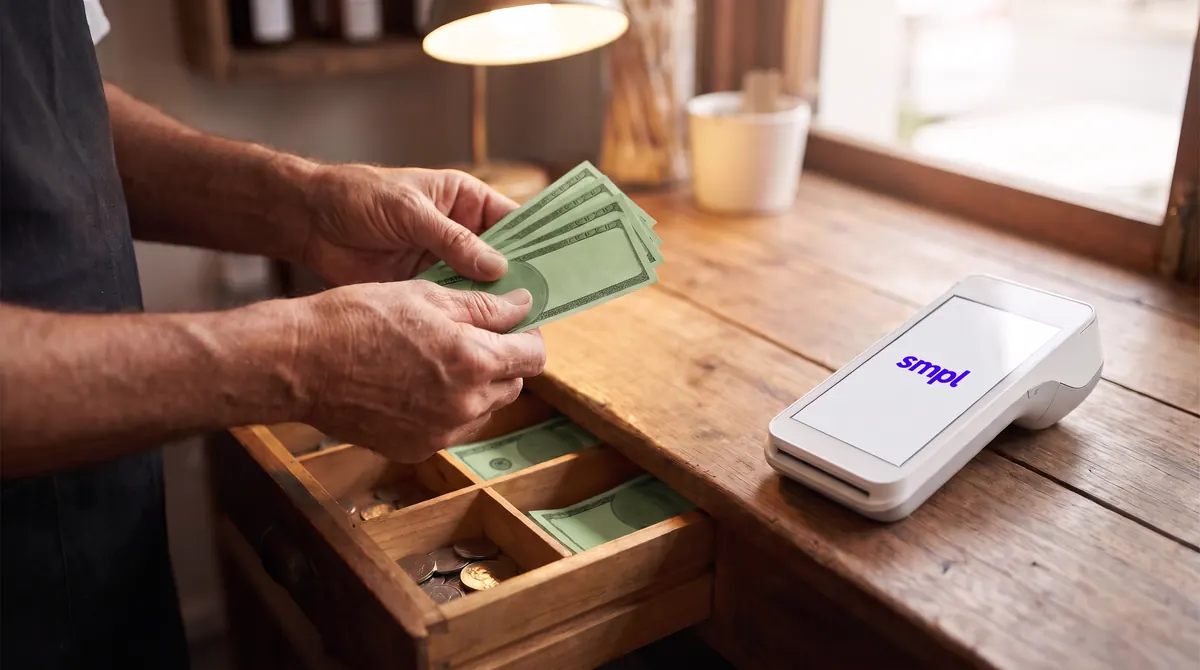
A terminal that applies the discount
The terminal needs to apply the cash discount at checkout and print compliant receipts. Device support and compliant implementation are confirmed during onboarding.
This page is about card payments at a business. It is not about the accounting term for early-payment discounts.
In a cash discount program, the price you post for every item is the card price. A customer who pays with cash gets a discount at checkout. The business receives the posted price when the customer pays by card, and a lower, discounted price when the customer pays cash.
Illustrative example, not a quoted rate.

One price is posted for each item, and cash customers get a discount when they pay. Here is what that looks like in a normal sale.
Your menu, shelf tags, price list and website show one price for each item, and that price is the card price. A customer paying by card pays exactly what is posted.
A customer who chooses to pay with cash has the discount taken off at checkout. On a $103.00 item with a $3.00 discount, they pay $100.00 in cash.
The receipt records the posted price and the discount, so the sale is clear to the customer and to you. We confirm the exact screens and receipt wording with you during onboarding.
A cash discount and dual pricing both change what a customer pays depending on how they pay. The difference is what is posted. A cash discount posts only the card price and takes the discount off for cash at checkout. Dual pricing posts a cash price and a card price, and the customer chooses. A surcharge is a different thing again: a separate fee added at checkout when a customer pays by card.
The three side by side →Not much, and we help with all of it. Rules for pricing cash and card payments are set by the card brands and by each state, and they change, so we confirm a compliant setup with you before anything goes live.
The terminal needs to apply the cash discount at checkout and print compliant receipts. Device support and compliant implementation are confirmed during onboarding.
Customers should know about the discount before they pay. Your signs and receipts explain the program, and we set the wording up with you.
Onboarding is where we check your business type, your state and your card mix, and confirm a cash discount program is the right fit before you switch.
A cash discount program is not the better choice for every business. Here is where a different model usually fits better.
A posted card price reads oddly next to a quoted invoice. A predictable monthly subscription usually sits better with high-ticket or B2B billing.
Flat fee is usually the better fit →A cash discount program earns its keep on steady card volume. If your card takings are modest, per-transaction pricing is often the more honest fit.
Flat fee is usually the better fit →A cash discount means a cashier explains a discount at the register. If that conversation feels wrong for your team today, a flat monthly fee keeps one price on the register.
Flat fee is usually the better fit →Prefer one fixed number? Flat fee credit card processing keeps the cost with your business at one flat subscription.
In a cash discount program, the price a business posts for every item is the card price. A customer who pays with cash gets a discount at checkout. The business receives the posted price when the customer pays by card, and a lower, discounted price when the customer pays cash.
They give a similar result by different routes. A cash discount posts only the card price and takes a discount off at checkout when the customer pays cash. Dual pricing posts both a cash price and a card price, and the customer chooses at checkout. How dual pricing works →
No. A cash discount starts from the card price and lowers the price for cash. A surcharge starts from one price and adds a separate fee when a customer pays by card. See the three side by side →
Rules for pricing cash and card payments are set by the card brands and by each state, and they change. SMPL confirms a compliant setup with you during onboarding. This page is general information, not legal advice.
You need a terminal that can apply the discount at checkout and print compliant receipts, plus clear signs and receipt wording. Device support, eligibility and compliant implementation are confirmed during onboarding before you switch. See the devices →
Smpl also supports competitively priced traditional processing, including flat fee and pay-as-you-go pricing, if a cash discount program is not the right fit for your business. See flat fee pricing →
There is no long-term contract and no cancellation fee, and new merchants get a 30-day free trial. Any hardware you have taken is returned when you close the account, and anything supplied on separate terms is set out in writing during onboarding.
Last reviewed: November 2026. General information, not legal advice.

Send us a recent processing statement and we will show you what changes, line by line. No card required, and no obligation.